
Wedding | Linh & Hung

Tell us a little about yourselves!
We are quite different in temperament and in the things that naturally draw us in. Linh is instinctively drawn to culture, art and craftsmanship, and tends to be the more dreamy and imaginative one, while Hưng approaches the world more pragmatically. Our personalities often work in contrast too: one of us is more intuitive and instinctive, while the other is more structured and grounded.
What has always held us together is a shared set of core values: curiosity, respect for where we come from, openness to different cultures, and a desire to keep learning and evolving. We also believe that fate may bring two people together, but a relationship still needs to be consciously nurtured and cared for. We have never felt that being a couple means becoming alike; rather, two people can remain distinctly themselves while continually finding ways to understand and complement one another. That idea became a recurring language throughout our wedding, expressed through Tương Thông, meaning mutual connection and understanding between distinct worlds, and through the image of the sun and moon shining in different ways, yet existing in harmony within the same order.
Why did you decide to get married where you did?
Huế was chosen because it held a deeply personal connection for us while also reflecting the things we are most drawn to as a couple: history, heritage, traditional craftsmanship and a sense of place. Huế is my (the bride’s) maternal hometown and is connected to some of my most treasured memories of my mother and her family. We had always imagined that, if we held an intimate destination celebration, it would be in Huế or Hội An, but ultimately Huế felt like the place where our personal history and our shared interests could meet.
For the wedding itself, we wanted somewhere that genuinely belonged to Huế rather than a conventional hotel or a newly created “heritage-inspired” venue. We found Lan Viên Cố Tích through Huế designer Trịnh Hoàng Diệu, who introduced us to her close friend, Dr. Thái Kim Lan. Lan Viên is her home, the ancestral house of the Thái family and the Museum of Ancient Ceramics from the Hương River, surrounded by a living Huế garden. It felt less like choosing a wedding venue and more like being invited into a piece of Huế itself. We deliberately kept our intervention minimal so that the house, garden, objects and history could remain the experience.
How many guests did you have?
85 guests.
Tell us about your outfits.
Our outfits were designed as a contemporary conversation with Huế and the wider visual language of East and Southeast Asia, rather than as literal reproductions of historical dress. Across the weekend, we worked with Vietnamese designers and incorporated materials, techniques and motifs connected to the region's cultural heritage. For the July 3 welcome dinner, the bride wore a contemporary áo dài by Huế designer Trịnh Hoàng Diệu in purple and teal silk organza, with an elongated scarf that moved softly in the evening air. The groom wore a shortened interpretation of the traditional men's áo dài, combining silk brocade with sheer organza and featuring an embroidered Chùa Cầu motif across the back.
For the wedding day, the bride's look brought together ceramic, Huế painted enamel (pháp lam), textile and floral craft. Its centrepiece was a sculptural ceramic corset painted with cranes, stylised clouds and waves inspired by Huế's imperial decorative vocabulary, paired with a dramatic gold cape. Her flowers were carried in a miniature pháp lam-inspired teapot, referencing the Nguyễn court motif Cành Vàng Lá Ngọc, or “Golden Branches and Jade Leaves.” The groom wore a traditional áo dài ngũ thân specially gifted by Trịnh Hoàng Diệu, reinterpreted with long draped sleeves, crochet detailing and sun-and-moon embroidery. He paired it with a single turquoise earring and an organza fan decorated with a teacup motif.
Our outfits were designed as a contemporary conversation with Huế and the wider visual language of East and Southeast Asia rather than literal reproductions of historical dress. For the welcome dinner, the bride wore a purple-and-teal silk-organza áo dài by Huế designer Trịnh Hoàng Diệu, while the groom wore a shortened men’s áo dài in silk brocade and sheer organza, embroidered with Hội An’s Chùa Cầu (covered bridge) as a symbol of connection and cultural exchange, different worlds remaining distinct while still finding a way to reach one another. For the ceremony, the bride combined ceramic, Huế painted enamel (pháp lam), textile and floral craft, centred around a sculptural ceramic corset and a Cành Vàng Lá Ngọc (Golden Branches and Jade Leaves) -inspired teapot bouquet. The groom wore a traditional five-panel áo dài ngũ thân, gifted by Trịnh Hoàng Diệu, with draped sleeves, crochet detailing and a hand-embroidered landscape of mountains, rivers, the sun and the moon across the back.
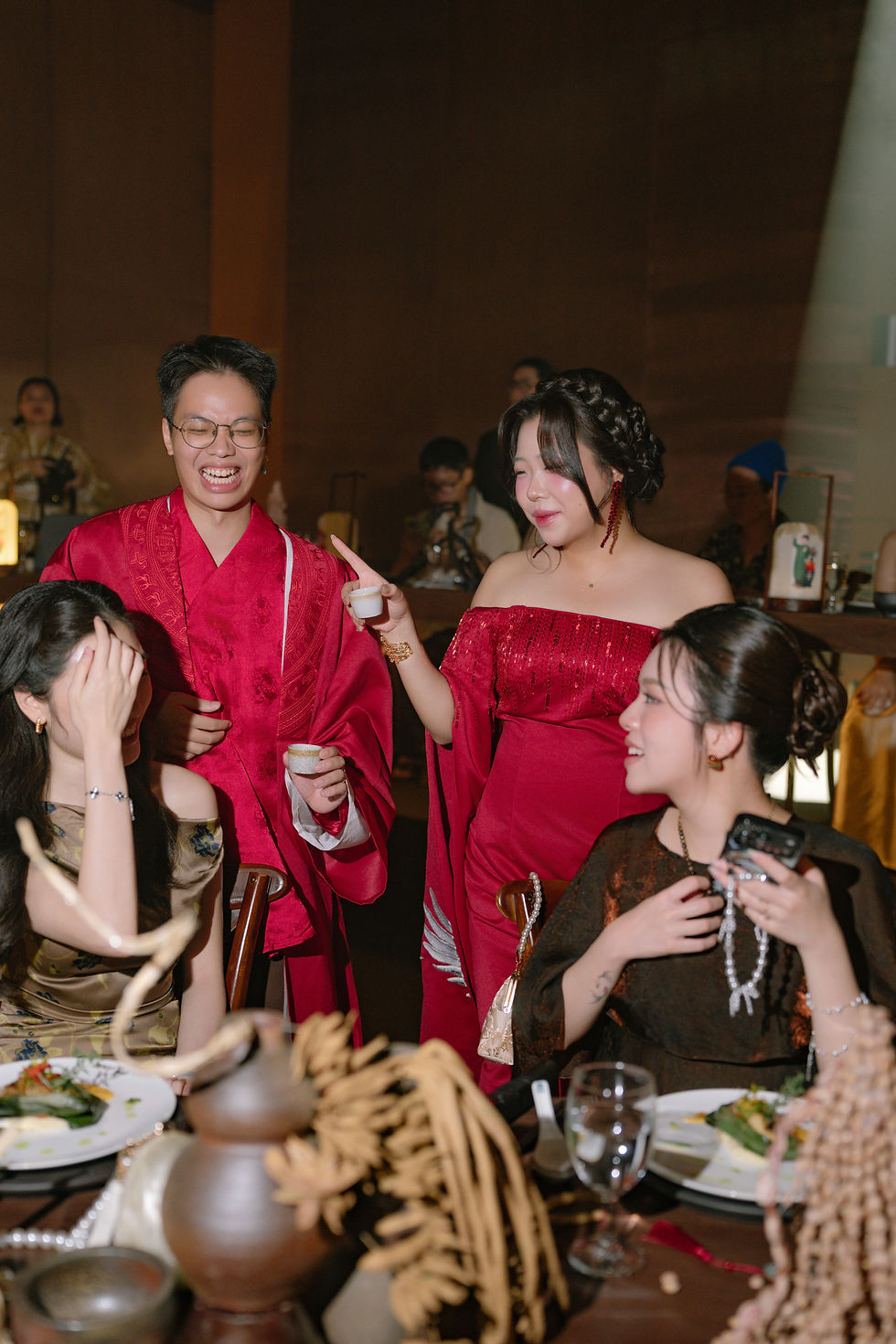
For our dinner reception Thăng Yến, we both returned to red. The bride wore a dramatic red gown with elongated slit sleeves and sweeping crane embroidery, while the groom’s look was constructed in three layers: an inner áo giao lĩnh (cross-collared robe), a sheer organza layer that created movement, and an outer áo đối khâm (front-opening robe), embroidered with motifs inspired by the Vietnamese Đông Sơn bronze drum. Across the wedding weekend, tradition was never treated as something fixed; each look explored how inherited forms could remain recognisable while being worn, reinterpreted and made personal today.
What was the most important aspect for you, in terms of planning your wedding?
The most important thing was creating a wedding that felt of the place rather than simply set in the place. We did not want to recreate a generic destination wedding and add Vietnamese details as decoration. We wanted our guests to experience Huế through its architecture, gardens, food, clothing, craftsmanship, rituals, music and hospitality, while allowing those elements to remain authentic to themselves.
This also meant resisting the temptation to over-design the spaces. At Lan Viên Cố Tích especially, we wanted to intervene as little as possible. The house, garden, ceramics and objects already carried so much history and beauty that our role was primarily to reveal and connect what was already there.
Were there any elements that were important for you to incorporate?
The entire wedding weekend was structured around the concept of Ngũ (五), or fivefold systems, which are deeply embedded in Vietnamese philosophy, ritual and everyday life. These included the Five Elements, Five Flavors, Five Confucian Virtues, Five Colors and Five Blessings. Each celebration took place in a different setting and explored a different aspect of this larger framework, allowing the wedding to unfold as one continuous story rather than as a collection of unrelated events.
For Huế, we wanted the cultural elements to feel lived-in rather than ornamental. Tea, traditional dress, imperial motifs, ceramics, painted enamel, garden architecture, river travel, craft and symbolism all became part of the experience. One particularly meaningful example was the July 2 tea journey, where guests travelled along the Perfume River and participated in a lùng tùng drum-making workshop led by Mệ Hường, an artisan in her eighties. It gave our guests the opportunity not simply to look at a tradition, but to meet someone who continues to keep it alive.
At our dinner reception Thăng Yến, that idea became a fully immersive experience. Rather than a conventional dinner reception, we created a ceremonial pavilion with circular inner seating within a square structure - referencing the traditional idea of trời tròn, đất vuông, or round heaven and square earth. The tables continued the Ngũ concept through the five tastes: bitter, salty, sweet, sour and spicy, while each course was paired with Vietnamese music or performance traditions from different regions. Suspended at the centre was a custom-made đèn kéo quân, a traditional spinning lantern featuring rotating imagery adapted from Đông Hồ folk paintings. We wanted culture to be encountered through all five senses rather than simply used as decoration.
Any tips for couples getting married?
Never stop learning, both about the world and about each other. We believe a relationship should allow both people to keep growing, rather than asking either person to become smaller for the sake of the other. Encourage one another to study, explore, change and pursue new ambitions, even when that growth takes you somewhere unexpected.Most importantly, grow together. There will naturally be moments when one person moves faster or has more capacity than the other, but marriage, to us, means making sure no one is left behind. Sometimes you lead, sometimes you wait, sometimes you help the other catch up, but you continue moving in the same direction.
For the wedding of your dream, start with what you want your guests to feel, rather than what you want the wedding to look like. Once that is clear, every decision from the venue and food to fashion and music has a reason to exist, and it becomes much easier to distinguish what genuinely belongs in your wedding from what is simply beautiful.If you are working with cultural traditions, understand why something exists before deciding how to reinterpret it. And sometimes the best design decision is restraint: when a place, craft or tradition already carries its own beauty, you do not need to reinvent it. You simply need to give people a way to experience your special day.
Are there any vendors that you would like to tell us a little more about?
Ha Nguyen captured the weekend with a sensitivity to the atmosphere and sense of place that were so important to the couple. Because the celebration unfolded across the Perfume River, historic garden houses and Lan Viên Cố Tích, the photography needed to capture not only the people and details, but also the quiet rhythm, architecture, landscape and cultural character of Huế. Ha’s work allowed those elements to become part of the story rather than simply serving as a backdrop to it.
The F Lab was instrumental in bringing the couple’s larger vision together across the multi-day celebration. The wedding was designed as a continuous cultural and sensory journey rather than a single event, and the team helped translate that concept into experiences that felt cohesive while remaining true to each setting.
We would also highlight Trịnh Hoàng Diệu, whose contemporary interpretations of Vietnamese dress became an important creative thread throughout the celebrations, and Mệ Hường, whose lùng tùng drum-making workshop gave guests a rare opportunity to engage directly with a living Huế craft tradition. Together, these collaborators helped make the celebration feel deeply connected to Huế rather than simply inspired by it.



Photographer: Ha Nguyen @hanguyenphoto | Planning, Flora, Concept & Decoration: The F Lab @theflab.weddingplanner | Videographer: Jacob Films @_jacobfilms | Tea Party Location: Hueritage Cruises @hueritage.vn | Welcome Dinner Location: Ancient Hue House @ancienthuegardenhouses | Ceremony Location: Lan Viên Cố Tích | Reception Location: Indochine Palace Hue @indochinepalace
.hue | Celebrant: Tung Nguyen & Katherine Tran | Ceremony Space: Lan Viên Cố Tích | Bride's HMUA: Quí Đoàn Makeup @quidoan3105 | Groom's Hair Stylist: Quynh Anh | Catering: Azerai La Residence Hue @azerailaresidencehue | Beverages: Indochine Palace Hue @indochinepalace.hue | Groom's Birthday Cake: Marslow Taste @marslow.taste | Stationery: The F Lab @theflab.weddingplanner | Entertainment: Wedding: Meritorious Artist Loc Huyen; Da Nang Traditional Art Theatre; Vietnam National Traditional Theater; “Âm Sắc Việt” band. | Jewellery: Dương Jewelry @duongjewelry | Bag: Simone Rocha @simonerocha_ | Bridesmaids Gifts: Maison de Nguyễn fragrance @maisondenguyen | Bride's Hairpin: Burmese jadeite | Groom's Earring: traditional Tibetan adornment. | Silk Dress: Bon
nie & Clyde @bonnieclyde.vn | Welcome Dinner Dress & Wedding Ceremony Suit: Trinh Hoang Dieu; Wedding Day Dress & Welcome Dinner Suit: Nguyen Nhat Nghi | Cape: JUNBYYANGJUN @junby
yangjun | Shoes: Dries Van Noten, Loro Piana; Wedding Day: Dries Van Noten, Christian Louboutin |


